

Introduction
“The fault, dear Brutus, is not in our stars, but in ourselves.”
William Shakespeare, Julius Caesar
All drugs (and vaccines) are toxic, it’s just a matter of dose. And all empires end, it’s just a matter of time.
There is a broad consensus that all empires eventually fail, often abruptly and catastrophically, a paradox that is one of the great puzzles of modern thought. The study of Anthropology, Archaeology, and human History often revolves around attempts to understand how civilizations rise and fall. When we study these things in the present, we frequently look to the past to predict our future by analogy. The most commonly cited example being the narrative portrayed in the “Decline and Fall of the Roman Empire” (1776-1788), by English historian Edward Gibbon.
The long-standing narrative emerging from Gibbon’s scholarship has created a centuries-long Western cultural consensus that underpins modern Western geopolitical military/defense strategy. This interpretation of recorded events is that the Goths, a Germanic people originating from Scandinavia and later settling in eastern Europe, were “barbarian invaders” who sacked Rome and contributed to the fall of the Western Roman Empire. Therefore, the lesson learned is that sovereign nation-states must maintain an effective, economically viable, central governmental State apparatus and a strong, externally focused military to serve as a barrier against foreign invasion and specifically against being sacked in one way or another. According to this version of history, it was the combination of Roman political corruption and the degradation of the Roman Empire’s military capabilities that enabled the Gothic incursion and subsequent period of socioeconomic chaos.
But is this the best analogy for the modern Western Imperium and its capital in Washington, DC? Is the combination of political and economic corruption, coupled with external military invasion, the most likely path for the eventual fall of the post-World War(s) American Empire?
The concept of the Fourth Industrial Revolution describes the ongoing transformation of society, economy, and industry driven by the fusion of technologies that blur the lines between the physical, digital, and biological spheres. Unlike previous revolutions, it is characterized by unprecedented velocity (exponential pace), scope (affecting all sectors globally), and systems impact (transforming entire production, management, and governance systems).
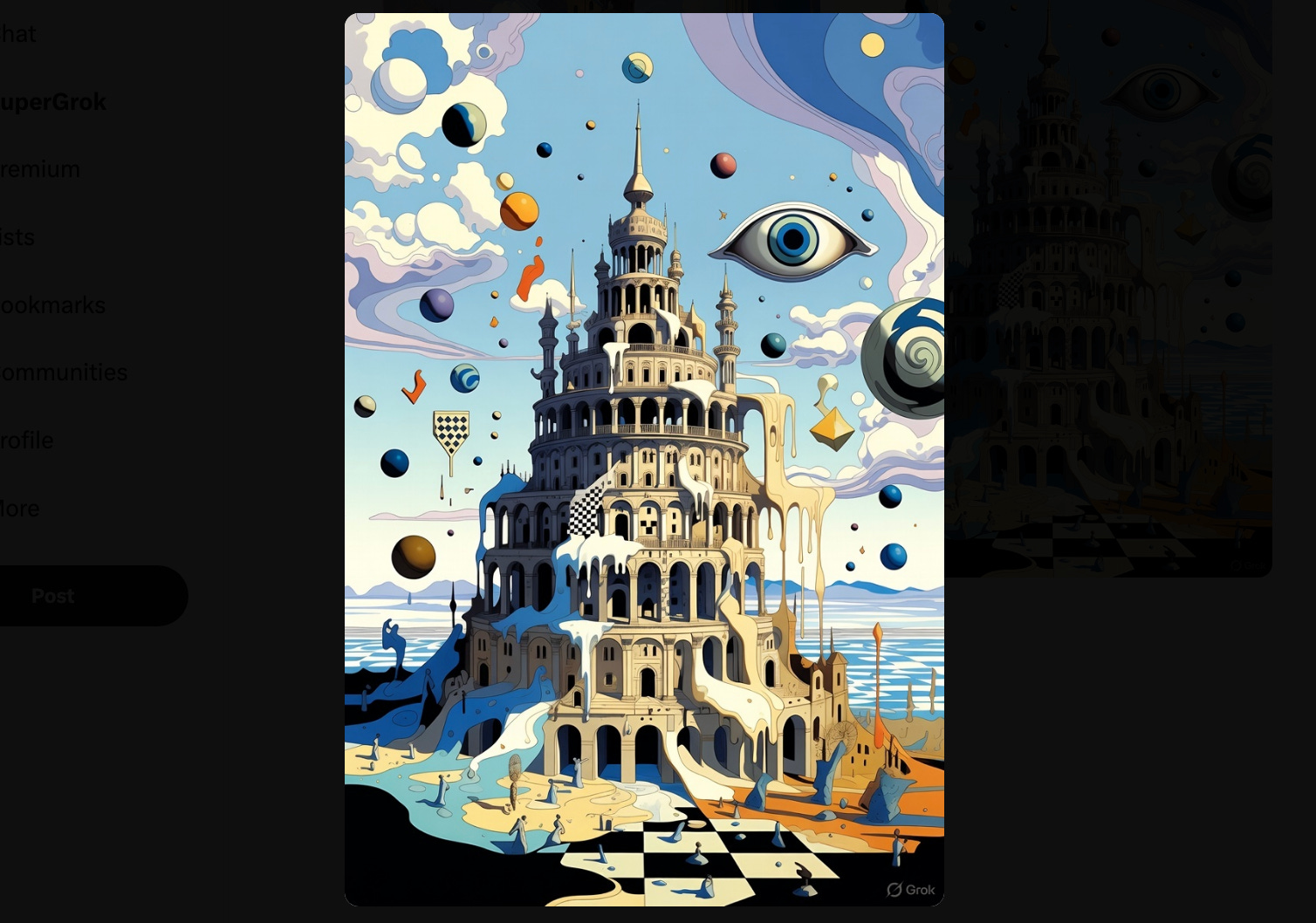
Rather than the fall of Rome, other analogies may better fit the emerging data patterns that describe the Fourth Industrial Revolution. These include the biblical parable described in Genesis 11 as the “Tower of Babel” and, for want of something more precise, the concept that “reality” as we currently experience it is a synthetic illusion, as cinematically portrayed in the “Matrix” film series. From my point of view, the eventual collapse of the current empire will most likely be multifactorial, more akin to an “all of the above” option in a multiple-choice test. As to what lies beyond the collapse horizon, all bets are off as far as I am concerned- too many variables.
The Tower of Babel story in Genesis 11 describes humanity united by a single language, collaborating to build a towering city “with its top in the heavens” as an act of collective ambition and defiance. God confounds their speech, scattering them and fracturing their unity into diverse languages and cultures. Anyone following the splintering of the internet and broader cultural fragmentation can see the parallels.
The synthetic reality portrayed in the “Matrix” draws on a Platonic allegory, Plato’s most famous thought experiment from “The Republic”. Prisoners chained in a cave mistake the shadows projected on a wall for reality, unaware of the world beyond. The community that has developed around Unexplained Aerial Phenomena (UAP) observations (eg. observational and physical data) is among those most actively exploring the idea that modern Physics and the nature of the universe as currently conceived may not reflect “true” reality, much as Plato’s cave shadows are a projection.
To further illustrate this concept, Stephen Hawking’s final theory, developed with collaborator Thomas Hertog, proposes that the universe is a holographic projection where time is an emergent dimension encoded on a timeless, two-dimensional surface. This model redefines the origin of the universe, suggesting that the Big Bang marks the beginning of time and physical laws, not a point in time, and that the past does not extend beyond this holographic origin. This is one set of concepts that may account for the repeated perverse observations and object behavior associated with UAP/UFO sightings.
In contrast and more consistent with currently accepted models of reality, a recently published, peer-reviewed economic analysis of the growth of computing power, the increasing sophistication of artificial intelligence, and the impact of fourth industrial revolution trends on the value of human labor provides insights into how a version of the surreal synthetic “reality” portrayed in “The Matrix” may be inevitable even absent extraterrestrial intervention.
Rethinking the Gothic Invasion
One emerging characteristic of the Fourth Industrial Revolution is the migration of displaced human populations. Patterns of displacement, migration, and immigration are common during periods of major socioeconomic change, and have become both common features of the emerging transformational change as well as opportunities to advance various political agendas.
In contrast to popular interpretations, the UN protects the rights of people who migrate and supports safe, orderly migration, but it does not establish international migration itself as a fundamental human right. Border control and immigration decisions remain sovereign prerogatives under international law.
A new narrative accounting for the “Fall of the Roman Empire” has been developed, which, to no surprise to anyone paying attention, aligns with modern Western thinking on the more permissive international migration policies that have become common in most Western Nation-States. In this version of the story, in 376 AD, the arrival of the nomadic Huns from Central Asia created a domino effect. The Huns displaced the Goths, forcing large groups—estimated at tens of thousands, including warriors, families, and civilians—to seek asylum across the Danube River into Roman territory. Led by Fritigern (Visigoths), they petitioned Roman Emperor Valens for permission to settle in Thrace, promising to become loyal subjects and provide military auxiliaries.
This was not an invasion but a mass migration of displaced people fleeing violence. Roman policy had long accommodated barbarian groups as foederati (federated allies): disarming them, scattering settlements, and integrating them for manpower and taxes. Valens initially agreed, seeing potential recruits for Roman Legions to fight on the Persian frontier. However, corrupt Roman officials exploited the refugees: withholding food, forcing sales of children into slavery for meager rations, and failing to properly resettle them. Starvation and abuse sparked revolt and the eventual invasion and sack of Rome by Roman trained and equipped Gothic soldiers.
The lesson being widely interpreted from this is that when confronted by invasion via immigration, Western states should emphasize policies of tolerance, support, and assimilation rather than militarized border control.
At this point, the predominant result of these policies observed throughout the Western Nation-States that have adopted them seems to be a form of cultural empathetic suicide.
Suicidal empathy is a political term popularized by evolutionary psychologist and author Gad Saad (a professor at Concordia University). It refers to excessive or misdirected empathy that prioritizes compassion toward out-groups, adversaries, or perceived victims in ways that ultimately harm one’s own society, culture, or civilization. This potentially leads to its decline or “suicide.”
End of Empire consequent to passive, woke, left-wing empathy. The road to the hell of civilizational collapse having been paved by good intentions.
The Tower of Babel
Every time I see some clip or reel of Yuval Harari discussing how, in the coming nirvana of computation, robotics, and transhumanism, God will be obsolete (or dead) and men will become as Gods, my mind goes to the parable of the Tower of Babel (Genesis 11:1–9). But during a recent discussion with Jeff Nucetelli, Justine Isernhinke, Jill and me, I realized that the splintering of the internet and culture in general is already effectively creating the conditions described in Genesis 11.
Now the whole earth had one language and the same words. And as they migrated from the east, they came upon a plain in the land of Shinar and settled there. And they said to one another, “Come, let us make bricks, and burn them thoroughly.” And they had brick for stone, and bitumen for mortar. Then they said, “Come, let us build ourselves a city, and a tower with its top in the heavens, and let us make a name for ourselves; otherwise we shall be scattered abroad upon the face of the whole earth.” The Lord came down to see the city and the tower, which mortals had built. And the Lord said, “Look, they are one people, and they have all one language; and this is only the beginning of what they will do; nothing that they propose to do will now be impossible for them. Come, let us go down, and confuse their language there, so that they will not understand one another’s speech.” So the Lord scattered them abroad from there over the face of all the earth, and they left off building the city. Therefore it was called Babel, because there the Lord confused the language of all the earth; and from there the Lord scattered them abroad over the face of all the earth.
Genesis 11:1-9, New Revised Standard Version Catholic Edition
The biblical Tower of Babel story (Genesis 11:1–9) is an etiological myth explaining the origin of diverse languages and human dispersion. It depicts a unified humanity building a tower “with its top in the heavens” out of pride, prompting God to confuse their language and to scatter them, thereby halting construction. The name “Babel” plays on the Hebrew word for “confusion” (balal), though the actual Babylonian name Bab-ilu meant “Gate of God.” Scholars widely agree that the story draws inspiration from the real Etemenanki Ziggurat in Babylon, a massive stepped temple dedicated to Marduk, rebuilt on a grand scale by the Neo-Babylonian kings Nabopolassar and Nebuchadnezzar II in the 6th century BCE. This structure symbolized human ambition to bridge earth and heaven, and its ruins or incomplete state may have influenced the narrative. The story likely took shape or was finalized during the Babylonian Exile (c. 586–539 BCE), when Jews lived in Babylon and encountered its culture, including the ziggurat.
In the current period, this narrative has long served as a powerful metaphor for cultural splintering: a once-cohesive group splinters due to communication breakdowns, leading to isolation, misunderstanding, and the emergence of distinct identities. In my recent experience, the “Medical Freedom” movement stands out as one example among many. Of course, this tendency towards the splintering of communities is often intentionally accelerated by divisive strategies, such as the notorious weaponized accusation of “controlled opposition” leveled against movement leaders.
The confusion of tongues symbolizes how barriers in understanding, literal or figurative, can disperse people, fostering diversity but also division, conflict, and lost potential for cooperation. Scholars often interpret it as a cautionary tale about hubris, in which overreaching unity invites fragmentation, yielding a richer but more fractured world of nations, ethnicities, and traditions.
In addition, I would add Narcissistic Bias as a key factor, wherein (for example) social media keyboard warriors and influencers tend to assume that censorship, harassment, deplatforming, and shadowbanning/small rooming are specifically and personally directed at them, when in fact they are more likely the consequence of algorithmic coding and structures.
In the context of the internet and social media, the Tower of Babel metaphor takes on a fascinating duality; sometimes evoking unity, but more often highlighting modern cultural splintering. On the one hand, the internet initially appeared as a reversal of Babel: a global “tower” of connectivity that enabled instant translation, universal access to information, and borderless collaboration. It promised to rebuild what was lost: humanity speaking a common digital language, achieving feats unimaginable in isolation. However, in practice, the internet has accelerated cultural splintering in ways that echo (and amplify) the biblical confusion:
Echo Chambers and Filter Bubbles: Algorithms curate feeds to reinforce existing beliefs, creating ideological silos where users rarely encounter dissenting views. This fosters “selective permeability,” where groups develop their own jargon, memes, and narratives, basically modern “languages” that outsiders struggle to comprehend.
Polarization and Fragmented Reality: Social media doesn’t just divide left from right; it fragments within groups (e.g., factions in politics, academia, or families). As psychologist Jonathan Haidt argues, platforms have “dissolved the mortar of trust” in shared institutions and stories, turning a potentially unifying tool into a fragmenting force. Recommended for further reading on this topic is Haidt’s essay “The Devil’s Plan to Ruin the Next Generation”.
Digital Tribes — Online communities form around niche identities, amplifying tribalism. What starts as connection often ends in misunderstanding, outrage, and scattering—much like the builders unable to coordinate amid confusion. Again, please see “outrage farming”, “Bad Jacketing”, and reflect on the multiple examples you may have seen over the last few years that have splintered the “medical freedom movement”.
This phenomenon is emergent from design choices: engagement-driven algorithms prioritize division for retention, turning the web into a cacophony of incompatible and incomprehensible worldviews. It is a natural and predictable outcome of the interaction between today’s on-line community in a digital commons in which all information and communication is being actively shaped and algorithmically nudged by a wide range of commercial and geopolitical actors seeking to control all knowledge, thought, and emotions.

Economic Drivers of a “Matrix” Future
Few who have watched “The Matrix” film series have not had their worldview impacted in some way. For example, the “blue pill, red pill” metaphor has become a Western cultural staple. Most are either consciously or subconsciously aware of the creeping penetration of computational technologies and Narrow Artificial Intelligence into their daily lives. But few have considered or formally modeled and analyzed the structural economic impacts likely to arise from further AI development and integration into the economy. A recently published, groundbreaking book chapter does just that, pointing towards an eerie future with a very “Matrix”-like aspect, in which the contribution of human labor value to Gross Domestic Product approaches zero.
Narrow AI (Artificial Narrow Intelligence, also called Weak AI):
The only type that exists today. It excels at specific, well-defined tasks but cannot generalize beyond them.
Examples: Voice assistants (Siri, Alexa), recommendation systems (Netflix, Amazon), image recognition, chatbots like ChatGPT.
All current AI, including advanced models, falls here.
General AI (Artificial General Intelligence, AGI, also called Strong AI):
Theoretical AI that can understand, learn, and apply knowledge across any intellectual task at a human level, adapting to new situations without retraining.
No examples exist yet; it’s a major research goal.
Super AI (Artificial Superintelligence):
Hypothetical AI that surpasses human intelligence in virtually every domain, including creativity, reasoning, and problem-solving.
Raises ethical concerns about control and impact.
Artificial Intelligence Classification by Capabilities
This chapter, from the forthcoming book The Economics of Transformative AI (edited by Ajay Agrawal, Anton Korinek, and Erik Brynjolfsson, University of Chicago Press, 2025), examines the long-run economic implications of Artificial General Intelligence (AGI)—defined as AI capable of performing all economically valuable work using computational resources (compute) without needing human input.
Restrepo argues that in the upcoming AGI-driven economy, humans “won’t be missed” economically. Growth and production would continue unabated without human effort. Traditionally, work provides not just income but purpose and societal contribution; AGI severs this link, raising profound questions about meaning, redistribution (e.g., beyond simple universal basic income), and redefining human value outside economic productivity.
The chapter uses formal economic modeling (building on growth theory, such as Jones 1995) to derive these outcomes, emphasizing the prioritization of allocating scientific computational capability to achieve optimal welfare during the transition. It paints a future of immense abundance but potential human irrelevance in production.
This is a third and very different version of how the current “world order” ends, not with a bang, not with cultural collapse consequent to human flaws, but rather with a whimper, as the contribution of humans to the overall global economy and global gross domestic product approaches zero, and computational capacity coupled with robotic technologies and energy become the rate-limiting factors controlling the global economic future.
Key Concepts
Bottleneck vs. Supplementary (Accessory) Work:
Bottleneck tasks are essential for unconstrained economic growth (e.g., scientific research, infrastructure, energy production).
Supplementary tasks are non-essential and do not limit overall growth.
In an AGI world, all work becomes automatable with sufficient computational capability, shifting the core economic challenge to allocating growing (but finite) computational resources efficiently.
Main Economic Predictions
Automation of Bottlenecks: To maximize growth, AGI prioritizes and fully automates bottleneck tasks first, as human limitations would otherwise constrain expansion. This leads to sustained exponential growth driven solely by increases in computational capability and technological progress (e.g., allocating computational capability to R&D).
Human Labor’s Fate:
Humans may continue performing supplementary work, but their economic contribution becomes marginal.
Wages for human labor become bounded by the cost of the computational capability required to replicate that work with AGI.
Over time, labor’s share of GDP converges to zero, and wages stagnate or decline relative to exploding output—decoupling human prosperity from economic growth.
No Singularity, But Robust Growth: Growth remains exponential but bounded (no infinite singularity), as it depends on scalable computational capability rather than scarce human labor.
Transition Dynamics: The shift to AGI could be smooth if limited by computational capability availability, but “jagged and uncertain” if constrained by technological breakthroughs in AGI capabilities.
In summary, this chapter explores the long-run implications of Artificial General Intelligence (AGI) for economic growth and labor markets. AGI makes it feasible to perform all economically valuable work using computational capability. The author distinguishes between bottleneck and supplementary work- tasks essential vs. non-essential for unhindered growth. As computational resources expand: (i) the economy automates all bottleneck work, (ii) some supplementary work may be left exclusively to humans, (iii) output becomes linear in compute and labor and its growth is driven by the expansion of compute, (iv) wages converge to the opportunity cost of computational resources required to reproduce human work, and (v) the share of labor income in GDP converges to zero.
This is the financial scenario underlying the famous World Economic Forum predictions such as “you will own nothing and be happy”. But it is also the scenario under which coders become completely redundant, but skilled tradesmen (and women) performing tasks that cannot be done by highly skilled robots - the few “physicals”- become the only people capable of compensated work. The obvious extension is that the Overlords of the “New World Order” will be those that control the bulk of future computational processing capacity.

In Conclusion
All empires will eventually end, it is just a matter of time. Their endings are almost always unanticipated, particularly by the elites that control them. And the ending is often abrupt and catastrophic. In many cases, the roots of the collapse often lie in fundamental human (and biological) characteristics. The tendency to overpopulate and deplete critical resources. Cultural and political divisiveness and fragmentation. Armed combat. Mismanagement and poor leadership. Failure to adapt to changing conditions. But like the legend of the Phoenix, new human societies continually emerge from the ruins of failed civilizations and empires. This essay has explored three different models of how empires collapse, but the possibilities and alternative futures are endless.
“The future is already here — it’s just not very evenly distributed“
Futurist William Gibson, 1999
I often speculate that, over the near term, the only way out for those who crave freedom and autonomy is to throw yourself into the task of building sustainable local communities. My favorite examples being the decentralized Amish and Mennonite communities of faith, and Ayn Rand’s “Galt’s Gulch”. Galt’s Gulch (also called Mulligan’s Valley or Atlantis) is the utopian hidden society depicted in Ayn Rand’s 1957 novel “Atlas Shrugged”. It represents Rand’s ideal of a rational, productive world based on her philosophy of Objectivism, contrasting sharply with the collapsing collectivist society outside.
Core Principles and Rules
No Force or Altruism: The foundational oath is: “I swear by my life and my love of it that I will never live for the sake of another man, nor ask another man to live for mine.” This rejects sacrifice, looting (taking unearned values), and government coercion.
Pure Capitalism: All interactions are voluntary, value-for-value trades using gold as currency (backed by objective value). No taxes, regulations, or welfare.
Rational Self-Interest: Inhabitants pursue their own happiness and productivity without guilt. Work is chosen freely (many take humble jobs in the valley while hiding their true talents from the outside world).
Privacy and Merit: Admission requires joining the strike (against the surrounding collectivist society) and proving one’s rational productivity. No “looters” (those who live off others) are allowed.
As the careful reader can readily discern, I suspect that when the current Washington DC-centric International Empire and World Order comes to an end, it will fall victim to some combination of all three scenarios combined with a large serving of corruption and hubris. But time will tell, and maybe the timeline will extend beyond my own lifetime or even those of my grandchildren.
That said, my intuition is that the event horizon is closer than we suspect. Plan accordingly, and think for yourself.
If James Madison's thoughts, that a constitutional republic will survive only depending on the honesty of the population which I believe is true, then this US empire is, indeed, coming to an end.
The corruption is so rampant as to be mainstream throughout our government bureaucracy as well as in the leadership. There WILL be a reset, but I doubt it will come in time to keep us on top.
I finished reading Gibbon's book in August. I didn't realize at time of purchase that it was an abridged version, whittled down to a mere 1056 pages. That read will be a one and only.
The burnout period lasted until recently, when I began Michael Pillsbury's "The Hundred Year Marathon," recommended to me by someone on Substack, perhaps this very one (I can't remember). It's an explanation of the history behind our opening to China, and China's long game against the US. Long story short (gathered thus far) is that we thought China would be a useful Cold War partner in keeping the Soviets in check. We thought we'd play China, but China has played us. How very Sun Tzu.