

Audio Version:
By: Dr.s Jill Glasspool Malone and Robert W. Malone
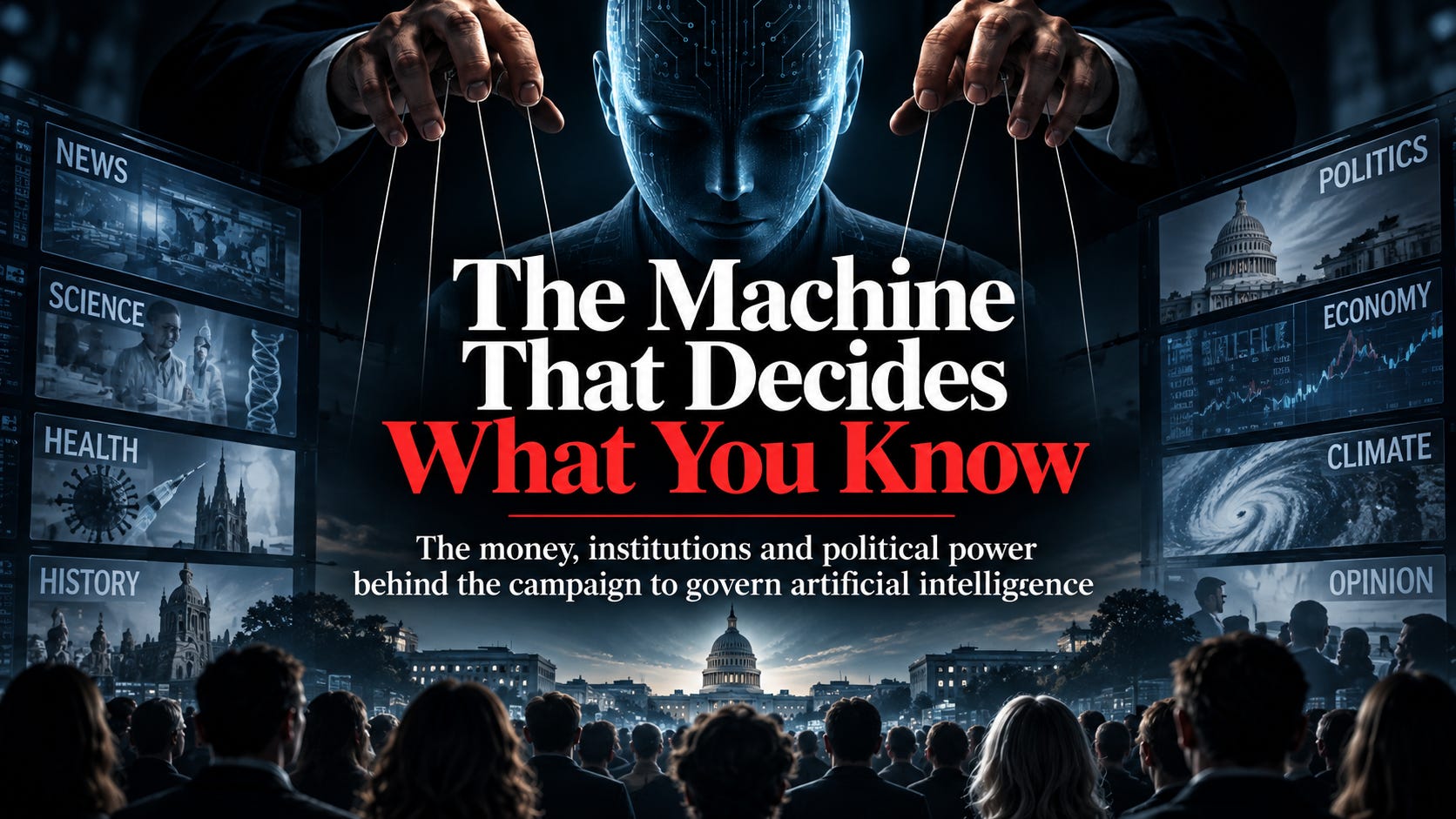
AI is rapidly becoming the gatekeeper to the world’s information. Increasingly, people will not search through ten websites and decide for themselves what they believe. They will ask a machine a question and receive an answer. That makes the rules governing those machines enormously important. Who decides which sources the machine trusts? Which claims it labels misinformation? Which questions it refuses to answer? Which information it never shows you at all?
Behind the increasingly urgent campaign to regulate AI is a surprisingly small and interconnected world of billionaires, foundations, nonprofits, researchers, policy organizations and technology companies. Many are connected through a movement most Americans have never heard of: Effective Altruism. Its money helped build the field of AI safety. Its institutions helped define the threat. Its researchers and policy organizations are helping define the solutions. And one of the world’s most powerful AI companies, Anthropic, emerged from this same intellectual ecosystem while spending tens of millions of dollars to influence the rules under which it and its competitors will operate.
Now Barack Obama wants Democrats to make AI regulation a major political priority.
That is where this story stops being about obscure arguments among computer scientists. The people who write the rules for artificial intelligence may ultimately help determine what the machine is allowed to tell you.
From Bed Nets to Human Extinction
Effective Altruism, usually shortened to EA, began with an attractive idea: if money is limited, spend it where it saves the most lives. One of the movement’s signature examples was the insecticide-treated bed net. Malaria kills hundreds of thousands of people each year, particularly children, and bed nets are cheap. Forget which charity tells the most moving story. Ask how many lives can be saved for each dollar spent. And EA had an immediate win: bed nets actually saved lives, cheaply, measurably and at scale. That was a powerful contrast to the billions routinely poured into ambitious vaccine research projects for malaria that produced disappointing results. EA could point to something tangible and say: this works. That logic directed early EA money toward malaria prevention, vitamin supplementation, direct cash assistance and other interventions where results could actually be measured.
Then the arithmetic changed.
An influential branch of EA embraced longtermism, the idea that the lives of people who may exist decades, centuries or even millennia from now should count heavily in decisions made today. Add existential risk, the possibility that humanity itself could disappear, and suddenly the numbers become almost infinite.
A bed net might save one child. Preventing human extinction, according to this logic, could save every human being who might ever live. And AI was increasingly cast as the threat that could end them all. If artificial intelligence carries even a small chance of causing human extinction, then controlling its development now becomes not merely another public-policy question. Within the longtermist calculation, it becomes a moral imperative of almost unlimited value.
Americans have seen this logic before. After 9/11, Dick Cheney developed what became known as the One Percent Doctrine: if there were even a one-percent chance of a catastrophic threat, the United States should treat that threat as a certainty when deciding how to respond. The doctrine helped frame the Bush administration’s approach to the War on Terror and the expansion of executive power that followed. Cheney also became a leading defender of the CIA’s “enhanced interrogation” program, including waterboarding. All justified under the One Percent Doctrine.
The parallel is important. Once the possible consequence becomes catastrophic enough, probability stops functioning as a brake on power. A remote possibility can justify an enormous response because the cost of being wrong is declared unthinkable. With Cheney, the nightmare was terrorists acquiring weapons of mass destruction. With AI longtermism, the nightmare is human extinction.
The mosquito net had become the machine.
How Money Builds a Consensus
Ideas require money before they acquire institutions, experts and political power. EA had plenty of it.
DataRepublican has done some of the most extensive work mapping this ecosystem, analyzing more than 25 gigabytes of records and tracing the recurring donors, foundations, nonprofits, university centers, researchers, policy organizations and journalists operating within it. Her work helped make visible what is difficult to see when each organization is examined separately: the same names, funders and institutions keep appearing.
At the center were Facebook co-founder Dustin Moskovitz and his wife Cari Tuna, whose Good Ventures became one of the principal financial engines behind the movement. Their philanthropic adviser, formerly called Open Philanthropy and now Coefficient Giving, poured money into global health, pandemic preparedness, biosecurity, AI safety, AI governance and the organizations being built around them.
But look at what the money actually buys. It doesn’t simply fund research. It builds a field.
Fund the researchers who define the threat. Fund the university centers that study it. Fund the organizations that evaluate the machines. Fund the fellowships that train the next generation of experts. Fund the policy shops that turn the research into proposed regulation. Fund journalism programs that explain the threat to the public. Then move those trained people into technology companies, think tanks, lobbying organizations, and government.
The accompanying Malone Institute research dossier maps this larger ecosystem, including Coefficient Giving, Good Ventures, Longview Philanthropy, the Survival and Flourishing Fund, EA Funds, 80,000 Hours and the network of AI-safety, evaluation and policy organizations they have helped support.
None of this requires a conspiracy. That is what makes the structure more interesting. People can sincerely believe the same thing while being funded, trained, employed and credentialed inside institutions built around that belief. Eventually the institutions begin citing one another. The researchers become the experts. The experts advise government. And what began as a philosophical argument starts looking like an independent scientific consensus. And the public is told that they need to trust “the experts”, that science is dictating policy. In reality, it is money that is dictating the policy.
Then comes Anthropic.
Anthropic Is Not a Charity
Then comes Anthropic.
Founded in 2021 by former OpenAI employees, including siblings Dario and Daniela Amodei, Anthropic develops Claude, one of the world’s leading AI systems. It emerged from the same intellectual world concerned with AI alignment and catastrophic risk, and built its public identity around safety.
But Anthropic is not an EA nonprofit. It is a commercial AI company competing for customers, computing power, government contracts and market dominance. Sincerity about AI risk does not eliminate financial interest.
Robert and I examined the economics of this in an earlier essay, What the AI Panic Is Actually About. The central problem is regulatory capture. Licensing, mandatory model evaluations, security programs, compute reporting, pre-release testing and armies of lawyers cost money. Anthropic can afford them. Startups, universities, and independent developers may not. Government does not have to ban a competitor. It only has to make competing too expensive.
And Anthropic is not sitting quietly while those rules are written. In 2026, the company committed $40 million to Public First Action, an organization advocating AI regulation, while Anthropic employees dramatically increased their own political giving. Anthropic has been unusually candid about its intention to influence AI policy.
The company warning government about the danger is also selling the product. The company advocating stronger regulation may benefit from the barriers that regulation creates. And the company asking government to build higher regulatory walls may be one of the companies best equipped to climb them.
And then there is an even more fundamental question: Who gets to decide whether Anthropic’s machines are safe?
Follow the Watchdogs
So who watches the companies building these machines?
One answer is METR, the Model Evaluation and Threat Research organization, a tax-exempt nonprofit increasingly positioned as an independent authority on whether frontier AI systems are dangerous. In August 2026, METR announced an extraordinary fundraising haul: roughly $71 million in new commitments in just six months.
From whom?
METR didn’t say. It thanked a long list of past and present supporters, but did not disclose who supplied most of the $71 million, how much each donor committed, or through which funding vehicles. Kevin Bass later went looking through the public record. His reconstruction found only one commitment that could be clearly matched to METR’s announced six-month fundraising window: a $350,000 Packard Foundation grant. The public source of roughly $70.65 million remains unidentified.
That is an extraordinary disclosure gap for a nonprofit positioning itself as an independent watchdog over one of the most powerful industries in the world.
METR acknowledges receiving substantial free model access and tokens from the very companies whose systems it evaluates. And with closed AI models, access is everything. An evaluator cannot walk into Anthropic, OpenAI or another laboratory and demand to inspect the machine. The company controls the model, the access, the technical cooperation and much of the information necessary to evaluate it. You do not need to write the watchdog a check to hold its leash.
Then read METR’s own May 2026 Frontier Risk Report. METR disclosed that when the project began it had no applicable personnel conflict-of-interest policy and conducted no formal recusal or disclosure process. Some staff had strong social relationships with employees of the AI companies being evaluated. METR operated from a research center that also hosted AI lab personnel. The participating companies provided complimentary model access, could require specified nonpublic information to be redacted and could quietly withdraw before final approval. METR even acknowledged that the pilot failed to comply with every requirement of the evaluator standard it was supposed to follow.
The question is why an organization with these dependencies and conflicts should automatically be described as an independent evaluator simply because Anthropic did not write it a check.
And METR is not an isolated institution. It grew out of the Alignment Research Center and sits within a larger world of AI-alignment researchers, evaluators, donors, contractors and organizations, including Redwood Research. The relationships overlap through funding, personnel, shared facilities, professional networks and access to the laboratories themselves.
That is the network Kevin Bass started following.
What Kevin Bass Found
Kevin Bass went looking for the money.
His public-records investigation traced the funding, personnel and institutional relationships surrounding METR, Anthropic and the larger EA-linked AI-safety network. What he found was not a neat conspiracy chart with one billionaire secretly writing every check. It was something harder to see and, in some ways, more important: a network in which enormous amounts of money move through foundations, donor-advised funds and nonprofits while the identities of the people ultimately supplying that money can disappear from public view.
METR is the clearest example. The nonprofit announced roughly $71 million in new funding commitments in just six months. Bass searched foundation databases, IRS filings, grant disclosures and other public records looking for the source. He could clearly match only a $350,000 Packard Foundation grant to that fundraising window. In the public records he examined, the source of roughly $70.65 million could not be identified.
The opacity goes deeper. METR’s publicly available tax filing reported millions of dollars from contributors whose identities are not disclosed on the public Form 990. Other money arrived through donor-advised funds, which can legally obscure the original donor. Bass found overlapping funders, institutional relationships, shared facilities and personnel connections throughout the larger AI-safety world. Meanwhile, AI laboratories provide evaluators with something almost as important as money: access to the closed models they are supposed to evaluate.
None of that proves that an unidentified donor controls METR or dictates its conclusions. It proves that the public cannot follow much of the money behind an organization increasingly presented as an independent watchdog over one of the most powerful industries on earth.
And that should be a problem all by itself.
Funding the People Who Explain the Danger
Then there are the journalists.
The Tarbell Center for AI Journalism trains and funds journalists covering artificial intelligence. Unlike much of the money surrounding this ecosystem, Tarbell’s funding is remarkably transparent. It lists Coefficient Giving, Longview Philanthropy and the Survival and Flourishing Fund among supporters giving more than $1 million. As of 2025, Tarbell says the majority of its funding came from Coefficient Giving, one of the principal philanthropic engines behind the AI-risk field.
Tarbell itself acknowledges the potential for “actual or perceived conflicts of interest” and says its donors have no control over what its journalists write. There is no evidence that Coefficient Giving sits in an editorial meeting ordering reporters what to say. But again, that misses the point.
The same philanthropic ecosystem helping finance the research into catastrophic AI risk is also financing journalists to explain catastrophic AI risk to the public.
Follow the information pipeline. Fund the research that defines the danger. Fund the organizations that evaluate it. Fund the policy experts proposing solutions. Then fund journalists who explain the danger to everyone else.
By the time Congress gets involved, the warnings appear to come from everywhere: researchers, nonprofit watchdogs, policy experts and journalists.
Follow the money backward, however, and many of those roads lead into the same remarkably small philanthropic ecosystem.
Obama Moves to Control the AI Rules
And then the money, the AI-safety movement and the campaign for regulation intersect with politics.
Barack Obama has been working on the politics of information control for years. As we documented in The Obama Machine: Netflix Was Only the Beginning, his April 2022 Stanford speech placed misinformation, technology platforms and government regulation into the same political framework. Artificial intelligence dramatically raises the stakes. Social media decides which human voices are amplified or suppressed. AI increasingly produces the answer itself.
Obama understands the distinction. His own Foundation now calls openly for public oversight of AI. Obama has described the technology as potentially more disruptive than social media and argued for a public regulatory structure to steer its development. The Foundation explicitly connects that project to misinformation, deepfakes, surveillance, information provenance and the need to structure the public conversation “in a trustworthy way.”
That language should sound unsettlingly familiar.
In September 2026, Obama moved from discussing regulation to Democratic political strategy. At a private Manhattan fundraiser, he urged House Democratic Leader Hakeem Jeffries to make AI policy a priority if Democrats regain the House and encouraged prospective 2028 presidential candidates to make AI safety and its economic consequences central issues.
The machinery was already being built. In December 2025, Jeffries created the House Democratic Commission on AI and the Innovation Economy, charged with developing policy expertise in partnership with the “innovation community,” other stakeholders and congressional committees.
So follow the progression. The philanthropic ecosystem finances AI-risk research, evaluators, policy organizations and journalism. Anthropic spends heavily to influence AI policy. And now one of the Democratic Party’s most influential figures is urging his party to make AI governance a major political project.
This establishes that enormous philanthropic, corporate and political interests are converging on the same question: who gets to write the rules governing the machines that will increasingly control how Americans obtain information.
Social media gave governments and technology companies enormous power over which voices could be heard. Artificial intelligence offers something much more powerful.
The ability to shape the answer before you ever see it.
Anthropic Goes to Washington
Anthropic is no longer merely warning government about AI. It is spending serious money to shape what government does about it.
In February 2026, Anthropic gave $20 million to Public First Action, a nonprofit advocacy organization promoting AI safeguards. Five months later, it gave another $20 million, bringing its commitment to $40 million. The purpose for that money is explicit: influence the public-policy debate over AI. Anthropic said it did not intend to “sit on the sidelines” while those rules were being written.
At the same time, Anthropic dramatically expanded its direct lobbying operation. Federal disclosures show the company spent a record $1.97 million lobbying Washington in the second quarter of 2026 alone, roughly $22,000 a day and more than it had ever spent in a previous quarter.
Put the pieces together.
EA-linked philanthropy spent years financing the intellectual infrastructure around catastrophic AI risk. Researchers defined the danger. Evaluators emerged to measure it. Policy organizations developed responses. Journalism programs helped explain the threat. Anthropic built one of the world’s most valuable AI companies around a safety-centered identity and is now spending tens of millions of dollars to influence the regulatory debate. Barack Obama is urging Democrats to make AI governance a major political project.
The people building the machines, the people defining the danger, and the people writing the rules are increasingly occupying the same small political sphere.
Safety for Whom?
The existence of risk does not answer the question at the center of this story: who gets to define the danger and write the rules?
Should billionaires finance the institutions that determine which risks matter? Should AI companies help finance the political campaign for regulations governing their own industry? Should evaluators dependent on access to closed corporate models be called independent? Should the same philanthropic ecosystem fund both the experts warning about catastrophic AI and the journalists explaining that threat to the public?
And then there is the money. The largest AI companies can afford mandatory evaluations, licensing, security requirements, lawyers and regulatory departments. Their smaller competitors may not. Regulation does not have to ban competition. It can simply make competition unaffordable.
That is the conflict buried beneath the language of safety.
The Censorship Question
This is where AI becomes fundamentally different from social media. Twitter could remove a post, throttle its distribution or suspend the person who wrote it. WikiLeaks could publish documents governments desperately wanted hidden, and once those documents were public, governments had to deal with the fact that people could read them. The fight over censorship was visible because the information existed outside the gatekeepers.
AI changes that equation. Control the training data, approved sources, system prompts, refusal rules and definitions of “misinformation,” “harmful content” or “dangerous capabilities,” and the unwanted answer will never reach you. WikiLeaks might exist, the documents might be sitting there in plain sight, and the machine could simply never tell you about them. A source is never offered. A question produces a refusal. A disputed historical event is presented as settled. You cannot know what the machine was instructed not to tell you.
That is why this regulatory fight is about far more than AI safety. These systems are rapidly becoming intermediaries between people and information. Increasingly, people will ask the machine rather than search the underlying record themselves. Whoever establishes the rules governing what those machines may say acquires enormous influence over what people are permitted to know.
There may be no Twitter Files next time, and no WikiLeaks archive that breaks through the censorship barrier.
The gate can be built into the machine.
Who Gets to Write the Rules?
Follow the money and the institutional structure becomes difficult to ignore. A small group of extraordinarily wealthy donors helped build the field devoted to catastrophic AI risk. Their money funded researchers, nonprofits, evaluators, policy organizations, fellowships and journalists. Anthropic emerged from that same intellectual world, built one of the most powerful AI companies on earth, and is now spending tens of millions of dollars to influence AI policy. The company itself says its $40 million commitment to Public First Action is intended to advance public education and AI policy. Barack Obama is now urging Democrats to make AI governance a political priority. None of this requires a secret meeting or a centrally directed conspiracy. Concentrated money, shared assumptions and aligned interests can accomplish plenty on their own.
The question is no longer whether artificial intelligence needs rules. Rules are already being proposed. Anthropic has published its own framework calling for progressively stronger external testing, incident reporting and government oversight as AI capabilities increase. The question is who writes those rules, who gets designated as the experts, who gets paid to enforce them, who can afford to comply with them, and who decides what these machines will ultimately be permitted to tell us.
That last question is the one Americans should pay very close attention to. Social media taught the public what happens when government, technology companies, academics and nonprofits begin policing the boundaries of acceptable information. AI moves that power upstream. There may be no deleted tweet to discover, no suspended account to restore and no WikiLeaks document breaking through the gate. The information can simply never appear in the answer.
Demand the disclosures now. Who funds the evaluators? Who funds the experts advising Congress? Who supplied the language in the legislation? Which companies met with regulators? Who benefits financially from the compliance requirements? And above all, what protections prevent government from turning “AI safety” into authority over lawful speech and information?
Because once the rules are embedded in the machine, censorship will no longer require taking information away from you. The machine simply won’t give it to you in the first place.
Support Independent Investigation
This essay began with a simple question: who is actually behind the campaign to write America’s AI rules? Answering it meant following money through foundations and nonprofits, reading tax filings and conflict disclosures, checking lobbying records, tracing institutional relationships and separating connections that can be documented from those that cannot.
That kind of work takes time. It is also exactly what Malone News is here to do. Not repeat the approved narrative, and not substitute speculation for evidence, but follow the money, read the documents and ask questions powerful institutions would rather nobody ask.
If you value this work, please consider becoming a paid subscriber. Your subscription makes investigations like this possible and keeps Malone News independent of the institutions being investigated.
Thank you for reading, sharing and supporting independent journalism.
Selected References
DataRepublican. “I Mapped 25+ GB of Effective Altruism.”
Bass, Kevin. METR Deep: Public-Records Reconstruction of METR Funding and Institutional Relationships.
https://github.com/kevinnbass/metr-deepMalone Institute. Effective Altruism, AI Institutions and Conflicts of Interest.
https://static1.squarespace.com/static/61910a2d98732d54b73ef8fc/t/6ab2888441243d50aab43637/1790085253543/EA_AI_Institutions_and_Conflicts_of_Interest.pdfMETR. “Funding Update.” August 14, 2026.
https://metr.org/blog/2026-08-14-funding-update/METR. Frontier Risk Report. May 19, 2026.
https://metr.org/blog/2026-05-19-frontier-risk-report/Tarbell Center for AI Journalism. “About: Supporters and Funding.”
https://www.tarbellcenter.org/aboutTarbell Center for AI Journalism. “Ethics and Standards.”
https://www.tarbellcenter.org/ethics-and-standardsAnthropic. “Anthropic Is Donating $20 Million to Public First Action.” February 2026.
https://www.anthropic.com/news/donate-public-first-actionAnthropic. “Anthropic Is Donating Another $20 Million to Public First Action.” July 2026.
https://www.anthropic.com/news/donation-public-first-actionIssue One. “Lobbying Disclosures Reveal Big Tech Spends More Than $226,000 Per Day to Buy Influence.” 2026.
https://issueone.org/articles/lobbying-disclosures-reveal-big-tech-spends-more-than-226000-per-day-to-buy-influence/Federal Election Commission. “Public First.” Committee filings.
https://www.fec.gov/data/committee/C00930503/Obama Foundation. “President Obama Calls for Public Oversight of AI, Warns of Disruption Ahead.”
https://www.obama.org/stories/president-obama-calls-for-public-oversight-of-ai-warns-of-disruption-ahead/Reuters. “Obama Voices Caution on AI, Urges Democrats to Tackle It.” September 13, 2026.
https://www.reuters.com/legal/government/obama-voices-caution-ai-urges-democrats-tackle-it-nyt-says-2026-09-13/Office of Democratic Leader Hakeem Jeffries. “Leader Jeffries Announces New House Democratic Commission on AI and the Innovation Economy.” December 9, 2025.
https://jeffries.house.gov/2025/12/09/leader-jeffries-announces-new-house-democratic-commission-on-ai-and-the-innovation-economy/Malone, Robert W. “What the AI Panic Is Actually About.” Malone News. September 2026.
https://www.malone.news/p/what-the-ai-panic-is-actually-aboutMalone, Robert W. “The Obama Machine: Netflix Was Only the Beginning.” Malone News. September 2026.
https://www.malone.news/p/the-obama-machine-netflix-was-onlySuskind, Ron. The One Percent Doctrine: Deep Inside America’s Pursuit of Its Enemies Since 9/11. Simon & Schuster, 2006. See also PBS NewsHour, “The One Percent Doctrine,” June 20, 2006.
https://www.pbs.org/newshour/show/the-one-percent-doctrine
If Obama wants it regulated, then it’s a terrible idea. Period!
Yaaaa, when you can’t see the funding you can assume a group is not independent. They’re too afraid to reveal their ‘daddy’.
Isn’t Datarepublican a treasure??