

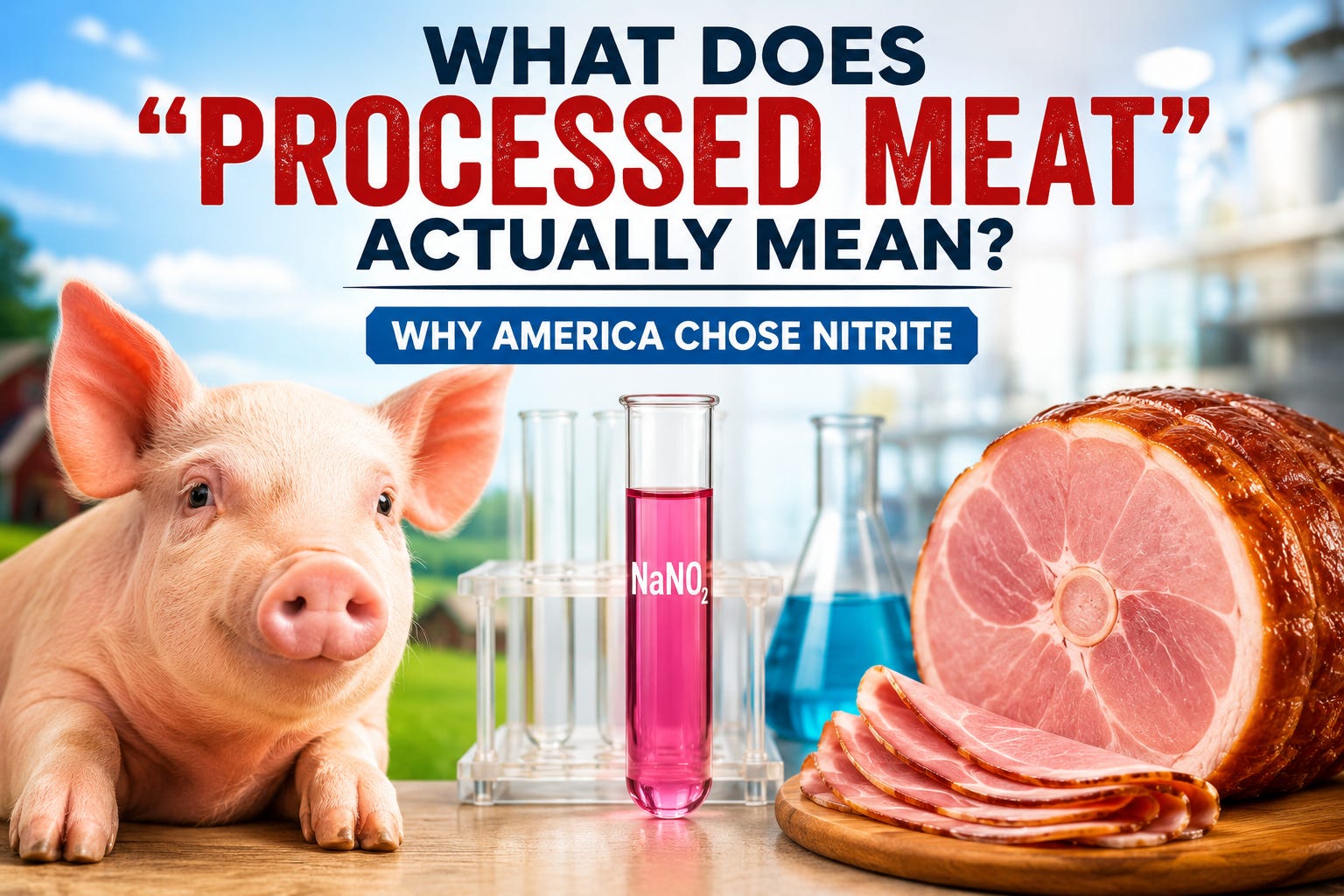
This essay is Part Two of the series
“The Processed Meat Problem.”
Part One is linked below:
Audio Version:
For thousands of years, virtually every culture on Earth processed meat. Without doing so, civilization itself would have looked very different. Salting, smoking, drying, fermenting, and aging meat were among humanity’s oldest food technologies, allowing families to survive winters, feed armies, travel long distances, and build thriving communities. In other words, processing meat is not a modern invention. It is one of mankind’s oldest survival skills.
Yet today, the phrase “processed meat” has taken on an entirely different meaning.
Processed meat is associated with cancer.
Processed meat is associated with heart disease.
Processed meat is associated with diabetes and shorter lifespan.
The phrase “processed meat” has become so familiar that we rarely stop to ask what it actually means. That is unfortunate, because the answer is surprisingly complicated.
In everyday conversation, “processed” has become almost synonymous with “factory-made.” We picture conveyor belts, stainless steel machinery, preservatives, additives, and shrink-wrapped packages under fluorescent supermarket lights. That image certainly depicts some, maybe most, processed meats in America, but it tells only part of the story.
Strictly speaking, every country ham is processed.
Every piece of bacon is processed.
Prosciutto di Parma is processed.
Jamón Ibérico is processed.
Traditional salami is processed.
Even the Virginia country hams that hung in smokehouses throughout the Blue Ridge for generations were processed.
The historic processing for many of these meats is simply salt, smoke, air, and time.
Different cultures solved the problem in different ways, but the underlying biology was remarkably similar.
Salt drew water from the meat and from the microorganisms that cause spoilage. As moisture declines, bacteria find it increasingly difficult to grow. Drying reduced water activity even further, making the meat an even less hospitable environment for pathogens. Smoke deposited compounds on the surface that helped slow spoilage while contributing flavor. Fermentation enlisted beneficial bacteria to acidify the meat, creating conditions that discouraged more dangerous organisms. Time allowed enzymes already present within the muscle to slowly transform texture and flavor, turning tough cuts into foods that could command extraordinary prices.
By the Middle Ages, entire regional cuisines had developed around these preservation techniques. Italy gave us prosciutto. Spain perfected Jamón Ibérico and Jamón Serrano. Germany developed hundreds of smoked and fermented sausages. France produced jambon sec and saucisson. Across the British Isles, Northern Europe, and eventually colonial America, every farming community developed its own methods for preserving pork. Virginia country ham belongs to that ancient tradition. No two hams were exactly alike, and that was part of their appeal. That philosophy began to change during the middle decades of the twentieth century. The transformation did not occur because traditional curing suddenly stopped working. It occurred because America itself changed.
Refrigerated transportation replaced local markets.
National grocery chains replaced neighborhood butchers.
Consumers increasingly expected the same product every time they opened a package, whether they lived in Richmond, Chicago, or Los Angeles.
Product conformity at the national branding level became a major marketing tool.
Self-stability saves money.
At the same time, processors faced growing pressure to reduce costs, shorten production time, minimize spoilage, and produce food that could be distributed across an entire continent and even globally.
One of the technologies that emerged from this period was the widespread use of sodium nitrite. Many people assume nitrite became common because the government required it. It did not.
The word “processed” gradually came to describe foods that shared very little beyond the fact that someone, somewhere, had altered them after slaughter.
A Virginia country ham aged for eighteen months, a Prosciutto di Parma cured with nothing more than sea salt, a traditional fermented salami, became equivalent to a supermarket deli ham injected with a curing solution, a finely emulsified hot dog, and even a can of Spam. All are commonly classified as “processed meat.” Yet these products differ dramatically in their ingredients, methods of preservation, curing chemistry, moisture content, microbial ecology, and degree of industrial processing.
That broad classification may be convenient for regulators and epidemiologists, but lumping all these products together lacks scientific precision. Grouping together traditionally preserved foods and modern industrial meat products may simplify public health messaging, but it also raises an important question: if these foods are fundamentally different, can we confidently assume they carry the same biological risks?
Why America Chose Nitrite
One question kept nagging at me as I researched this series.
If some of the world’s most celebrated cured meats, Prosciutto di Parma, Jamón Ibérico, and even a handful of surviving American country hams, can still be produced without added sodium nitrite, why did nearly every major American producer adopt it?
The answer turns out to have surprisingly little to do with government mandates.
Traditional dry-cured meats can still be produced in the United States without added nitrite. The USDA never required every country ham to contain nitrite. What changed was the regulatory burden. Producers relying on traditional curing methods had to validate their process, maintain extensive documentation, and demonstrate that it consistently produced a safe product. Industrial curing methods, by contrast, were easier to standardize, easier to monitor, and easier to defend before regulators. Over time, that difference helped push much of the industry toward chemical curing, not because traditional methods no longer worked, but because they became more difficult and expensive to justify under modern regulatory systems. Regulations rarely dictate technology directly. More often, they reward the technologies that are easiest to validate, standardize, and inspect. For big industry, regulations set a higher bar for competition to enter the marketplace. They view a higher regulatory burden as an asset, not a burden.
From an economic standpoint, this industrialized manufacturing system worked remarkably well. From a public health standpoint, standardization and consistency reduce the risk of acute foodborne illness.
Whether adding nitrites as well as GRAS ingredients improved overall public health, however, never seems to factor into the thinking of the CDC, FDA, or USDA, then or now, or the CDC predecessor, the U.S. Public Health Service.
Once that regulatory environment existed, sodium nitrite solved an extraordinary number of problems simultaneously...
It inhibits the growth of Clostridium botulinum, one of the most dangerous foodborne pathogens known. During the middle decades of the twentieth century, botulism had become one of the defining concerns of food safety and public health. Home canning received much public attention, but meat processors, researchers, and government agencies were equally focused on preventing Clostridium botulinum, the bacterium responsible for one of the deadliest known foodborne illnesses. Although foodborne botulism has always been exceedingly rare, the fear of this disease and its severity drove the search for preservation methods that could virtually eliminate the risk. Fear of botulism aligned perfectly with the economic interests of the rapidly growing processed food industry.
Sodium nitrite emerged as one of the most effective tools available, and its ability to inhibit C. botulinum growth became a major reason for its widespread adoption throughout the American meat industry. Ironically, because systematic national surveillance of foodborne illness did not exist before the twentieth century, we can never precisely quantify how much risk nitrite actually reduced in traditional cured meats. We know the concern was real, but the historical baseline against which its benefits are measured was never adequately documented.
Nitrite stabilizes the familiar pink color consumers have come to associate with cured meats. It contributes the characteristic “ham” flavor many Americans now expect. It reduces spoilage losses, improves shelf life, and allows processors to produce a more consistent product regardless of season or geography.
Perhaps most importantly, nitrite fit perfectly into the industrialization of American meat production.
Traditional country ham depended upon winter temperatures, experienced curing masters, carefully managed smokehouses, and months of patient aging. Every ham was slightly different. Nitrite allowed curing to become faster, more predictable, and easier to standardize across thousands… or millions of hams. In other words, nitrite was never simply a preservative.
Yet not everyone followed that path.
A handful of American producers, including Newsom’s Country Ham in Kentucky and artisan producers such as La Quercia in Iowa, still produce cured meats without added nitrate or nitrite, relying instead on the older combination of salt, carefully controlled drying, humidity, temperature, and time.
Europe took a different path. Rather than replacing many traditional curing methods with industrial ones, countries such as Italy and Spain largely preserved them. Under the Protected Designation of Origin rules governing products such as Prosciutto di Parma and Jamón Ibérico, producers must follow extraordinarily detailed specifications governing everything from the breed of pig and region of production to curing time, temperature, humidity, and final product quality.
Those products are not exempt from food safety regulations. Their traditional curing process is regulated. In the United States, regulators likewise require producers to demonstrate food safety, but American industry largely chose a different route. Technologies such as sodium nitrite, refrigeration, injected curing solutions, emulsifying agents, and standardized manufacturing made it easier to produce safe, consistent products on a much larger scale. That naturally raises another question.
If both methods can safely produce exceptional cured meats, are they biologically equivalent? Remarkably, nutrition science and public health have devoted relatively little attention to answering that question.
The Pig Changed Too
There is another variable almost entirely absent from discussions of processed meat, and it may be every bit as important as the curing process itself. Over the past seventy-five years, the pig has been transformed through modern genetics, breeding, and production systems. When most nutritional studies compare today’s processed meats with those consumed decades ago, they generally assume that the raw materials have remained constant. It has not. The commercial pig of the twenty-first century is a fundamentally different animal from the hogs that once wandered Virginia forests and supplied the country’s smokehouses.
The transformation did not stop with curing methods. The pig itself changed.
During the latter half of the twentieth century, animal breeders aggressively selected pigs for faster growth, improved feed conversion efficiency, larger loin muscles, and leaner carcasses. From an economic standpoint, it was a remarkable success. Producers could raise more pork using less feed, reducing costs while increasing production.
There were unintended consequences.
One of them was an increase in what meat scientists call PSE pork: pale, soft, exudative meat. Influenced by genetics, stress susceptibility, and production practices, PSE meat is pale in color, loses excessive moisture, has poor texture, and performs poorly during curing. It is far less suited to the traditional production of country ham and other dry-cured meats, which evolved around slower-growing animals carrying considerably more fat. While PSE meat is undesirable for premium whole-muscle products, many of its shortcomings can be masked when the meat is finely ground, emulsified, blended with other ingredients, and manufactured into products such as hot dogs, bologna, luncheon meats, and Spam.
As a young Animal Science student at the University of California, Davis in the early 1990s, I found that this story stayed with me over time. It illustrates a broader trend within modern agriculture. Animals were increasingly being optimized for industrial efficiency rather than for the quality of the food they produced or, in many cases, for their own long-term well-being. The industry solved one problem after another through genetics, chemistry, and engineering, but each solution often created a new set of challenges that required yet another technological fix. Looking back, it is hard not to think that American agriculture, as well as public health, lost its way.
Throughout much of the twentieth century, breeding programs selected for faster growth, leaner carcasses, larger loin muscles, improved feed efficiency, and greater uniformity. Commercial breeds such as Yorkshire, Landrace, Duroc, and their crosses gradually replaced many of the slower-growing heritage breeds that had supplied American smokehouses for generations.
The result was a pig that reached market weight sooner, consumed less feed per pound of grain, and produced substantially leaner carcasses. This fundamentally changed the raw material used to make traditional cured meats.
The Virginia country hams hanging in smokehouses a century ago generally came from slower-growing animals that carried considerably more fat. That fat was not merely stored energy. It contributed flavor, aroma, texture, moisture retention, oxidative chemistry during aging, and ultimately the eating quality of the finished ham.
Traditional curing evolved around those animals.
Modern industrial curing evolved around very different ones.
In other words, long before a pig ever encounters salt, smoke, nitrate, nitrite, or a smokehouse, the product had already begun to change. That observation raises yet another question that nutrition science has rarely addressed.
When researchers compare “processed meats” across decades, are they even studying the same animal?
Good science begins by asking good questions. This series is an attempt to ask some that are rarely discussed. If you enjoy long-form essays that combine history, agriculture, food science, and public health, I hope you'll join us.
Please consider becoming a free or paid subscriber to Malone News. Your support allows us to continue researching and publishing work that doesn't fit into a headline or a soundbite.
The Great Scientific Blind Spot
By now, it should be obvious that “processed meat” is not a single food.
It is not even a single method of preservation.
It is an extraordinarily broad category encompassing foods preserved by entirely different technologies, produced from genetically different animals, and manufactured using methods that range from centuries-old craftsmanship to highly automated industrial production.
At one end of the spectrum are traditional whole-muscle cured meats, products transformed slowly through salt, air, smoke, fermentation, and time. At the other end are highly formulated industrial products, injected with curing solutions, mechanically tenderized, emulsified, stabilized, cooked, packaged, and distributed through national supply chains. Between those two extremes lies an enormous diversity of foods that differ in their ingredients, chemistry, moisture content, microbial ecology, fat composition, and manufacturing processes.
But the story is even more complicated than that.
As discussed above, over the past seventy-five years, the pig itself has changed. Breeding programs selected for faster growth, leaner carcasses, improved feed conversion, and greater uniformity. At the same time, curing methods changed. Refrigeration changed. Distribution changed. Consumer expectations changed. Meat science changed. Even the economics of producing ham changed.
In other words, the exposure itself has not remained constant.
When epidemiologists analyze “processed meat,” they are not studying a single food. They are studying an evolving category that has changed continuously over time. A Virginia country ham hanging in a smokehouse in 1930, a Prosciutto di Parma produced under centuries-old Italian traditions, a supermarket deli ham injected with curing solution, and a modern hot dog manufactured from emulsified meat and injected with GRAS ingredients may all appear under the same heading in a food-frequency questionnaire.
From the standpoint of food chemistry, meat science, and biology, these are profoundly different products.
That does not mean the epidemiology is wrong. It does mean we should be cautious about assuming that one hazard ratio applies equally to every food placed into this remarkably broad category. Science advances by making careful distinctions, not by overlooking them.
That brings us to the central question of this series.
If “processed meat” is not one food, not one preservation method, and not even one type of pig, what exactly are the epidemiologic studies measuring? More importantly, which aspects of modern meat processing, if any, are actually responsible for the reported health risks?
Those are the questions we will tackle in Part Three, where we leave the smokehouse behind and enter the world of nutritional epidemiology, relative risk, absolute risk, and the evidence that has shaped public health recommendations around the world.
JGM
If you think this is a discussion worth having, please share this article. The more people who understand how our food changed, the better the conversation about where it should go next.
When I was young I used to hunt feral pigs on ranches in the NorCal area of rolling oat grass hills studded with large black oaks. The targets were the year old 100 lb shoats that had not yet started breeding. The red delicious meat was the polar opposite to PSE factory pork. Now I just source my pork from 'hippy farms' that run pasture raised pigs. Not a close second but good enough. I source my beef steaks from the northern Sierra Madre mountains of Mexico above Hermosillo. Until you eat this product you will not know what prime grade beef is actually supposed to taste like! (ps: the Romans and Druids were curing meats with potassium nitrite, aka saltpeter, 2000 years ago)
Thank you for these informative insights. Taken with many other threads of parallel, intertwining and intersecting warps and wefts, it becomes possible to glimpse patterns in the modern tapestry of our privileged lives; to understand a bit more context and eventually even to tease out a few golden strands of meaning. Such is the great value of this site. I am so very grateful to its creators and contributors (of all species)!